


Understanding Funeral Cards: What They Are and Why They Are Important
Funeral ceremonies are rooted in small rituals that help families honor and remember someone they loved. One of the most common, and most misunderstood, is the simple card handed to guests as they arrive or leave a service. Most people recognize funeral cards the moment they see one, yet few could explain where they came from or why funeral homes and families still rely on them today. Here is what they are, where the tradition started, and why they still matter.
What Are Funeral Cards?
Funeral cards, sometimes called memorial cards or remembrance cards, are small printed cards distributed during a funeral service or visitation. They typically feature a photograph of the deceased, along with their name and birth and death dates, and often a favorite quote, verse, or short poem. Unlike a full funeral program, which outlines the order of a service, a funeral card is meant to be carried home and kept.
What Funeral Cards Typically Include
- A photograph of the person being honored
- Their full name and birth and death dates
- A verse, scripture passage, quote, or short poem
- Occasionally, the date and location of the service itself
Families ordering a set for an upcoming service can pair them with printed prayer and memorial cards sized and finished for keeping, rather than a one time handout.
A Brief History of Funeral Cards
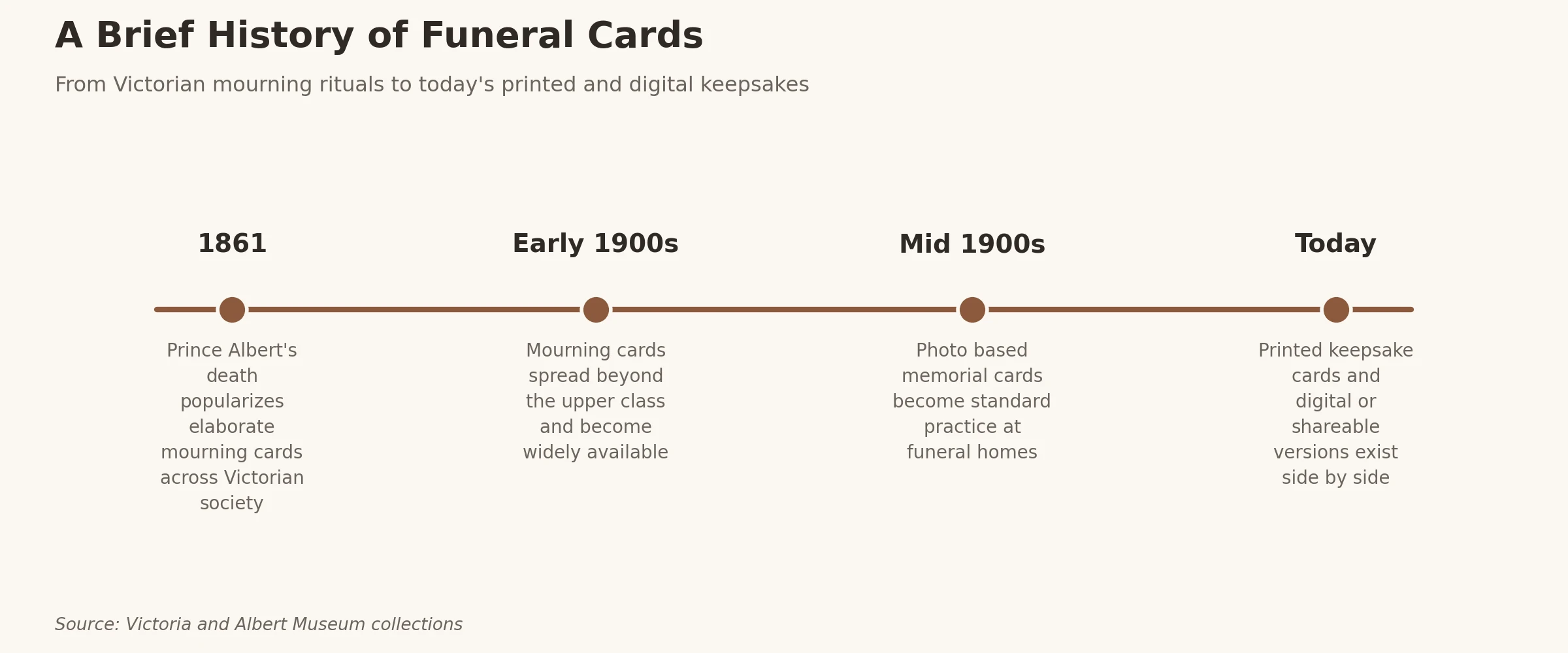
The tradition goes back further than most people expect. Death was highly visible in Victorian culture, and an entire industry of mourning dress and mementos grew up around public grief. The death of Prince Albert in 1861 is widely credited with popularizing the practice of sending beautifully embossed mourning cards in memory of the deceased, a ritual documented in the Victoria and Albert Museum’s collection. What began as a custom among the upper classes gradually spread across social classes and cultures, until it became the accessible, everyday keepsake it is today.
Why Funeral Cards Still Matter
Funeral cards serve several purposes at once, which is part of why the tradition has outlasted so many other Victorian mourning customs.
Honoring and Remembering a Loved One
A funeral card gives guests something tangible to take home as a personal reminder of the person who has passed away. Including a photograph lets mourners reflect on cherished memories and offers a quiet, comforting connection to the person being honored.
Sharing Essential Details
Funeral cards also serve a practical purpose. Alongside the personal details of the deceased, many include the time, date, and location of the service, which helps guests stay informed and arrive ready to pay their respects.
Comfort for Grieving Families
A card that includes a verse, scripture passage, or comforting poem can offer solace to those mourning the loss. Because the card is physical, mourners can revisit the words whenever they need them, long after the service has ended.
Preserving Family History
Over time, funeral cards become small pieces of family history. They document a person’s existence and are often tucked into a Bible, wallet, or photo album, where they get rediscovered and passed down through generations.
Choosing a Funeral Card Design That Fits
There is no single correct way to design a funeral card, and most stationers offer enough variety that families rarely feel boxed in. Religious services often lean toward a cross, dove, or stained glass motif paired with a scripture verse, while a more secular or nature inspired service might favor soft florals, a sunset, or a simple frame around the photograph. Color matters too. Many families choose tones that reflect the person’s personality or favorite color rather than defaulting to black and gray, which can make the card feel more like a celebration of a life than a somber formality.
The photograph is usually the detail families spend the most time on, and it is worth the effort. A clear, well lit photo that captures the person’s personality tends to mean more to guests than a formal portrait taken years earlier. If you are working from an older or lower quality print, reviewing photo preparation guidelines before submitting it for printing can help the image come out sharp rather than blurry or pixelated once it is enlarged on the card.
When to Order Funeral Cards
Most funeral homes and stationery providers can turn around a small order within a day or two, but ordering as soon as the service date and guest count are confirmed leaves room for proofing and any last minute wording changes. Rushing an order the night before a service rarely leaves time to catch a misspelled name or an incorrect date, so a little lead time goes a long way toward a card the family will be glad to keep.
Funeral Card Etiquette for Guests
If you are attending a service where funeral cards are offered, take only one per person and handle it with care. If you cannot attend but still want to show support, a condolence card or a short, heartfelt message to the family accomplishes the same goal. A funeral card is not just a piece of paper. It represents the connection and compassion extended to a family during a difficult time.
It is also worth knowing that guests are not expected to do anything further with the card once they take it home. Some people tuck it into a wallet or Bible, others place it in a frame alongside a photo, and plenty simply set it aside and rediscover it years later. There is no wrong way to keep one, and families should not feel obligated to follow up on whether a card was displayed or saved. Giving it out is the gesture. What a guest does with it afterward is entirely their own.
How Funeral Cards Differ From Prayer Cards
The terms get used interchangeably, but there is a useful distinction. A funeral card is typically a general keepsake featuring a photo and dates, while religious prayer cards usually center on a specific prayer, scripture, or devotional image tied to the family’s faith tradition. Many families order both for the same service, using one as a broader keepsake and the other for guests who share their religious practice.
Printed and Digital Funeral Cards Today
As mourning practices evolve, funeral cards have adapted alongside them. Printed cards remain the standard at most services, but digital versions shared by email, text, or social media have become common for families spread across different cities or countries. Some families now include multimedia elements, like a short video or audio clip, within a digital version. The format has changed, but the underlying purpose has not: giving people something meaningful to hold onto after they say goodbye.
Many families pair their thank you cards sent after the service with the same design used on the funeral card itself, which keeps the keepsakes guests receive feeling cohesive rather than like an afterthought.
Frequently Asked Questions
What is a funeral card?
A funeral card is a small printed keepsake distributed during a funeral service or visitation. It typically includes a photograph of the deceased, their name and birth and death dates, and a short verse, quote, or scripture passage. It is meant to be carried home and kept, unlike a funeral program, which outlines the order of the service itself.
What are funeral cards also called?
Funeral cards are also commonly called memorial cards, remembrance cards, or mass cards in Catholic traditions. The terms are largely interchangeable and refer to the same small, photo based keepsake handed out at a service.
Are funeral cards the same as prayer cards?
They are closely related but not identical. A funeral card is usually a general keepsake built around a photo and dates, while a prayer card centers on a specific prayer, scripture, or devotional image tied to a family’s faith tradition. Many families order both for the same service.
How many funeral cards should a family order?
Most families order enough to cover expected attendance, with extras for relatives who could not attend but will want one later. A funeral home or stationery provider can help estimate a reasonable count based on the guest list and venue size.
What should be written on a funeral card?
At minimum, a funeral card includes the person’s name and birth and death dates. Many families add a favorite scripture passage, quote, or short poem that reflected the person’s beliefs or personality. Service details, like the date and location, are sometimes included as well.
Planning Funeral Cards for an Upcoming Service
Choosing the right funeral card is one small decision among many during a difficult week, but it is one that guests will carry with them long after the service ends. Whether your family wants something traditional or a more modern, personalized keepsake, our full range of memorial keepsakes is built to make that choice easier during an already heavy time.
If you have questions about sizing, wording, or turnaround time before a service, reach out to our compassionate team at 323-290-2555, Monday through Friday from 9 am to 5:30 pm, or call Tech Support at 888-349-2530 on weekends.


