

Funeral Program Acknowledgment Wording That Feels Sincere
Writing an acknowledgment for a funeral program often arrives at exactly the wrong moment, when you are already carrying more than anyone should have to carry in a single week. Finding the right funeral program acknowledgment wording can feel impossible when your mind is exhausted and your heart is heavy. You may find yourself wondering who to thank first, or worrying that a short paragraph could never capture how grateful you feel toward the people who showed up, sent flowers, drove hours without being asked, or simply sat with you in silence when silence was all there was.
Below is a clear breakdown of what belongs in a well-written acknowledgment, who is customarily thanked, and ready-to-use wording you can adapt today. Keeping the wording simple is not a shortcut. For most families, it is the most dignified and respectful choice, and as the research further down shows, it is also a genuinely meaningful gesture for everyone who reads it.
How to Write a Warm and Respectful Acknowledgment
When you sit down to write this, your mind might feel completely blank. It is hard to find words when your heart is heavy, and you might wonder if it is okay to keep things short. Think of the acknowledgment as a quiet, heartfelt thank-you, written for the people who showed up for your family during one of the hardest times. It is a public expression of private gratitude, printed so that everyone who attends the service understands they were seen and appreciated. Unlike a personal card sent to a single recipient, this acknowledgment speaks to an entire community at once, including neighbors, coworkers, members of a faith congregation, and extended family who traveled from across the country.
The tone should feel warm without being overwrought. Grief has a way of making language feel either too formal or too raw, and you might worry about saying the wrong thing. The acknowledgment sits somewhere in the middle: composed enough to print, yet genuine enough to feel human. Families who struggle most with this section are often trying to say too much, when a few well-chosen sentences carry far more weight than a long paragraph attempting to account for every single gesture.

A well-constructed acknowledgment contains three things: a direct expression of gratitude, a brief mention of the specific kinds of support your family received, such as prayers, meals, flowers, phone calls, or simply a presence at the service, and a closing sentiment that offers peace or blessing to those reading it. One sentence for each is plenty. Most families place the acknowledgment on the back cover or the final section of the printed booklet, where it reads best in one or two short paragraphs. Think of that final spot like a quiet porch at the end of a long day: it should feel like a place where people can take a breath, not a crowded room where everyone is talking at once.
Why a Short, Sincere Thank-You Matters More Than You Might Think
It can feel strange to think of gratitude as anything more than good manners, but researchers have actually studied what expressing thanks does for the people who write it and the people who read it. The findings are worth knowing, especially when you are trying to decide whether a brief acknowledgment is “enough.”
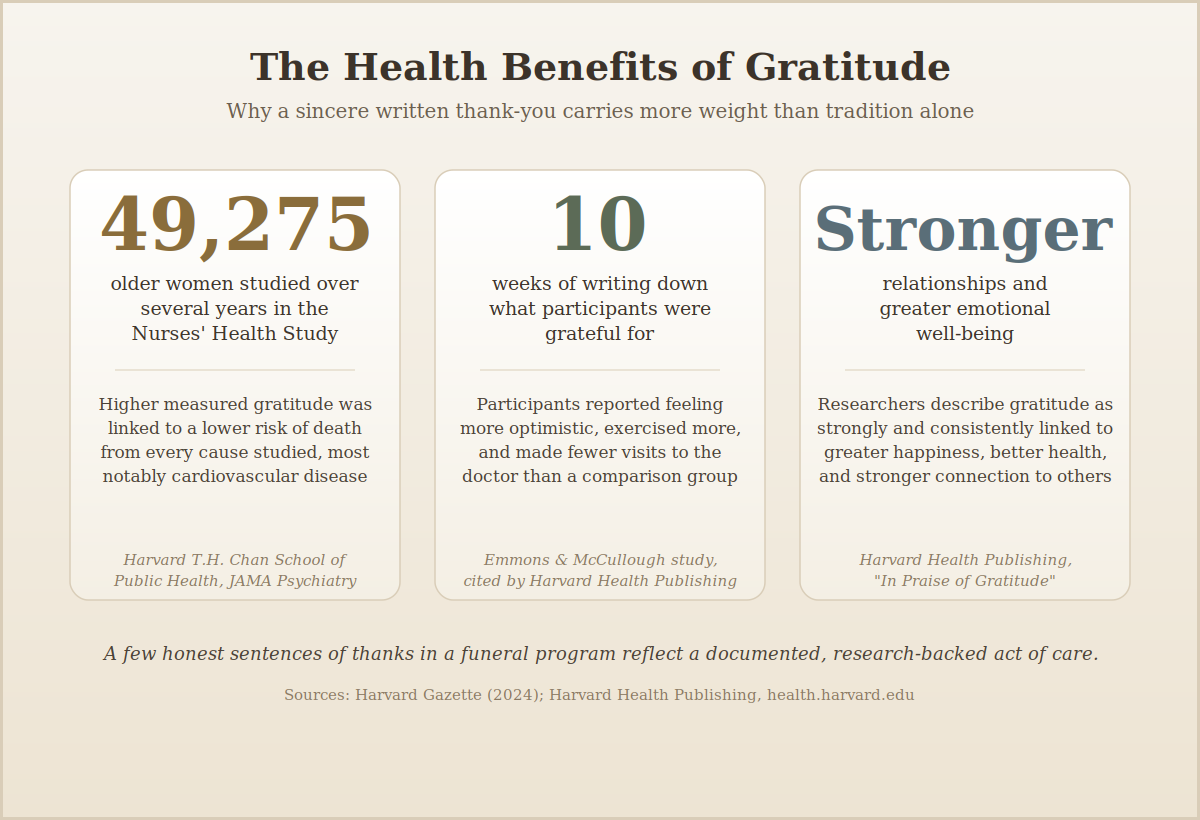
A study from the Harvard T.H. Chan School of Public Health, published in JAMA Psychiatry, followed tens of thousands of older women and found that experiencing gratitude was linked to a lower risk of death from nearly every cause studied, with the strongest protective effect against cardiovascular disease. Separate research summarized by Harvard Health Publishing found that people who spent ten weeks writing down what they were grateful for became more optimistic, exercised more, and visited the doctor less often than people who did not. None of this means a printed acknowledgment is a medical intervention, but it does help explain why families so often say that writing the thank-you, even a short one, felt surprisingly good to finish.
Who Should Be Thanked in a Funeral Program Acknowledgment?
When you are looking at a blank space, the fear of leaving someone out can make you freeze. Choosing who to thank works much like deciding who to include in a wedding toast: it is about the people who stood closest to you, not a complete inventory of everyone who sent a quick message. Trying to name every individual who offered condolences almost always creates more anxiety than it relieves. A general, warm statement that thanks everyone who supported you covers this ground beautifully, and guests will feel your gratitude without needing to see their name in print.
That said, certain roles are traditionally recognized by name or by group in American funeral programs. These are the people whose contributions were essential: they carried the casket, led the service, sang at the altar, or cared for your loved one in their final days.
Groups that are traditionally recognized in a funeral program acknowledgment include:
- Pallbearers and honorary pallbearers who carried the casket
- Clergy, officiants, or celebrants who led the service and guided your family
- Musicians, vocalists, or choir members who provided the music
- Medical staff, hospice caregivers, or home health aides who looked after your loved one
- Friends and neighbors who brought meals, helped with chores, or sat with you during the difficult days
These are traditional suggestions, not rigid rules. Every family’s circumstances are different, and some services, especially those arranged through smaller community churches, use a simpler acknowledgment that thanks everyone together. Trust your instincts about what feels right for the service you are planning. You know them best.
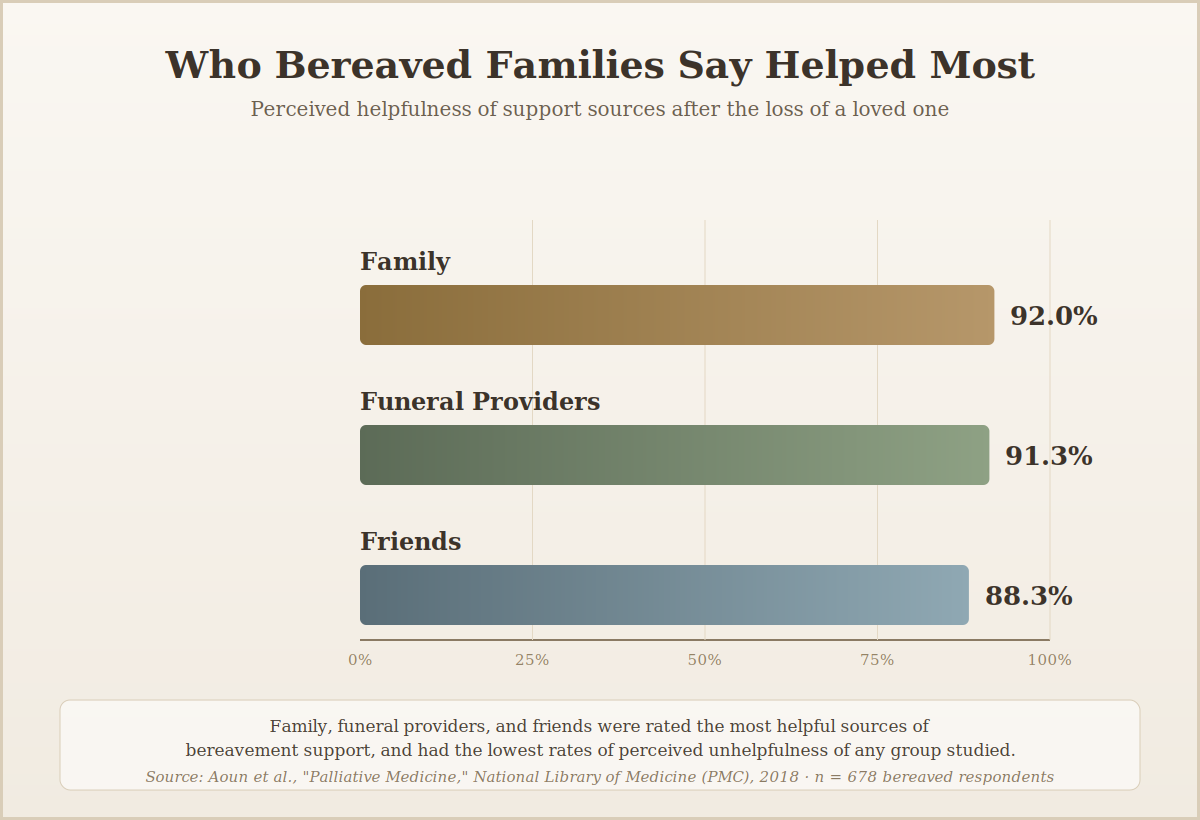
That instinct is backed by data. A population-based study published in Palliative Medicine and indexed by the National Library of Medicine surveyed 678 bereaved people and found that family, funeral providers, and friends were rated the most helpful sources of support, each above 88 percent, with the lowest rates of perceived unhelpfulness of any group studied. Formal counseling and support groups were used far less often and rated as less consistently helpful. In other words, the people the acknowledgment is built to thank, the family, friends, and funeral team standing closest to you, are the exact same people research shows made the biggest difference.
Funeral Program Acknowledgment Wording Examples You Can Use Today
Finding the right words when you are exhausted can feel like trying to write in a foreign language. It is completely natural to feel stuck, but having a few starting points can make the task much lighter. Funeral program acknowledgment wording does not follow a single set formula, and that is genuinely freeing once you accept it. Families planning a traditional religious service, a contemporary celebration of life, a graveside gathering, or a memorial following cremation all have different needs, and the wording should reflect the spirit of the day rather than a generic template.
Think about what your loved one would have recognized as authentic. If your family prayed together throughout an illness, you will naturally want to include your faith. If you are celebrating a life lived with humor and quiet joy, a warmer, simpler note fits best. A simple, sincere sentence always means more than elaborate words that do not feel like you.
Simple Funeral Program Acknowledgment Wording
Simple wording works well for families who want the acknowledgment to feel inclusive and unassuming, using language that any guest can receive warmly. These examples are short, and you can use them exactly as they are or add your loved one’s name.
- “The family of [Name] wishes to express their deep appreciation for your kindness and support during this difficult time.”
- “Thank you for your love, support, and presence as we celebrate the life of [Name].”
- “Your presence, comforting words, and acts of kindness have sustained us. We are deeply grateful for your warmth and friendship.”
- “We cannot fully express our gratitude for the love you have shown our family. Thank you for standing with us.”
You can follow any of these with a single closing line, like “May you be blessed for your generosity,” if you want a gentle closing without explicitly religious language.
Religious and Traditional Acknowledgment Examples
For families whose faith was central to their loved one’s life, the acknowledgment is a natural place to share that spiritual connection. These examples use traditional, comforting language that you can easily adapt to your own faith tradition.
- “We thank you for your prayers, love, and support. May God bless you for your kindness during this time.”
- “The family of [Name] is grateful for your prayers, your presence, and your acts of love. We pray that God blesses you as you have blessed us.”
- “Your prayers have been a comfort and a strength to our family. We thank God for placing such caring people in our lives.”
- “In our time of sorrow, your faith and your presence have carried us. May the Lord return to you the peace you have given us.”
A well-known verse has been printed in funeral booklets for generations because it does something simple prose cannot: it thanks everyone, from the friend who traveled across the country to the neighbor who simply kept your family in their thoughts. Placing a short verse like this near a small photograph of your loved one gives people a beautiful moment of reflection as the service ends.
What Not to Include in an Acknowledgment Section
The closing section of a funeral program is a space for reflection, and the acknowledgment should protect that quality rather than disrupt it. Keeping the words simple and clear is an act of consideration for the people reading them. A crowded final section can feel overwhelming during a sensitive time.
A few specific things tend to weaken an otherwise well-written acknowledgment. Overly detailed medical information, even when shared with love to honor a long struggle, belongs in the obituary rather than a short thank-you. Keep private family matters out of this space, since it is safer for everyone. Listing too many individual names can also backfire: if you accidentally leave someone out, it can cause quiet hurt during a time when everyone is already grieving. A warm, general thank-you protects everyone’s feelings.
As Frank Winkfield, Founder and Chief Executive Officer of Obituaries Tomorrow, often reminds families, every life is unique, and every tribute should reflect that individuality. That principle applies directly to this closing section: your thank-you should sound like your family, not like a pre-written form letter.
Funeral Program Etiquette for Acknowledgments
When you are trying to make decisions under the weight of grief, even small details like formatting rules can start to feel heavy. Knowing a few basic guidelines can help you make these choices with confidence. Checking them now prevents stressful mistakes later, so take your time.
| Guideline | What to Do |
|---|---|
| Placement | Put the acknowledgment on the back cover or the very last section of the booklet, where it reads as a natural closing gesture of gratitude. |
| Spelling | Double-check the spelling of every name you include, such as clergy, musicians, or caregivers. A misspelled name on a printed keepsake is hard to correct later. |
| Handling late gestures | Because printing happens before the service, flowers or help arriving that morning will not make it into the booklet. Thank those people with a personal card later instead of rushing them into the layout. |
| Group names | Verify the formal names of any organizations you thank, such as a specific hospital wing, care home, or church group, so the printed wording is accurate. |
The printed acknowledgment and the personal thank-you cards you send afterward serve different purposes, and understanding that difference takes some of the pressure off both. The printed version is a public, collective gesture that creates a permanent record of your family’s appreciation. Personal thank-you notes are private and specific, making them the best way to thank people who sent flowers, brought meals, or made memorial donations. Sending both is completely fitting, since they serve different purposes and both show real care.
Frequently Asked Questions About Funeral Acknowledgments
How long should a funeral program acknowledgment be?
Two to four sentences is usually the right length. The goal is a short, warm paragraph that fits easily on the final section without crowding the photos or design. If you find the text growing too long, some of those thoughts might belong in the obituary or a spoken eulogy instead.
Should we name specific individuals or thank everyone as a general group?
A mix of both works beautifully. You can thank specific roles, like the clergy who led the service or the caregivers who looked after your loved one, and then use a general statement to thank everyone else. This approach lets you honor the people who helped plan the day without worrying about leaving anyone out.
When should we send separate thank-you cards after the service?
Most families send personal thank-you cards within six to eight weeks after the service, though there is no strict deadline and a later note is always better than none. This timeline gives you and your family some time to rest and breathe before sitting down to write.
How do we write an acknowledgment for a veteran’s service?
A veteran’s service often includes military honors, like a flag presentation or the playing of Taps. You can easily mention these in your thank-you. For example, you might write: “We also extend our heartfelt thanks to the honor guard who provided final military honors.” Many families find that specialized layouts with military insignia make this process simpler.
What should we do if someone was accidentally left out of the acknowledgment?
Sending a handwritten personal thank-you card is the best way to handle this. In the note, simply explain that you had a lot on your mind, express your gratitude for their help, and let them know how much they meant to you. Most friends will understand completely, since they know how many details you were managing during a difficult time.
Reach Out to Us Today
Taking this one step at a time is the only way to move through it. Your acknowledgment does not need to be a literary work of art. It only needs to be sincere and true to your family. The people who showed up to support you will not remember if the phrasing was perfect, but they will remember that you took a moment, in the middle of your grief, to say thank you.
When you are ready, choose two or three of the phrases above that feel most like your family and write them down. If you would like help pulling the rest of the design together, you can reach out to our design team for guidance.
You are also welcome to browse our full collection of funeral stationery and keepsakes for design ideas that fit your family’s style. We work with families across the United States to make this step simple and steady.


